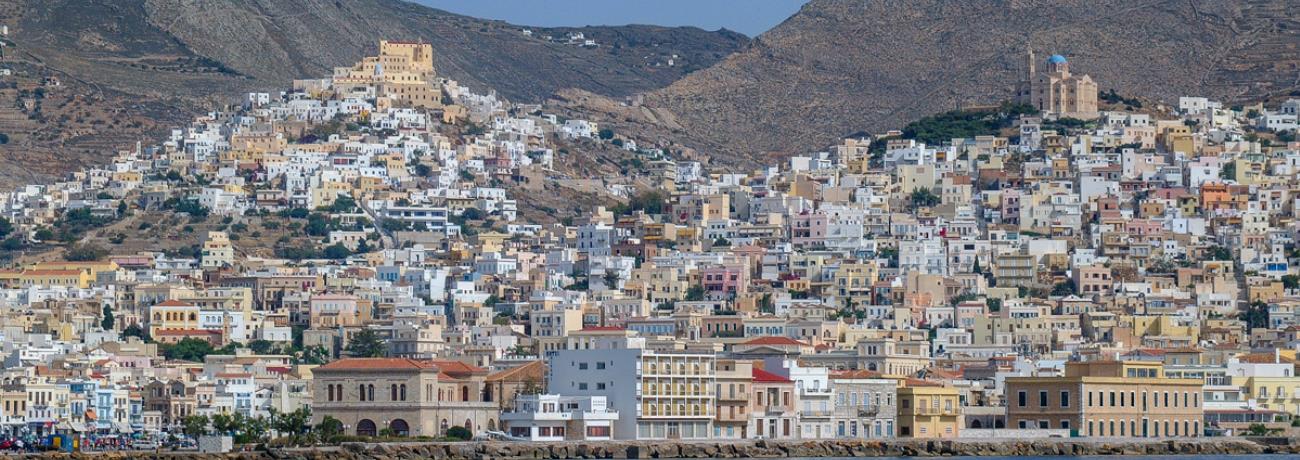
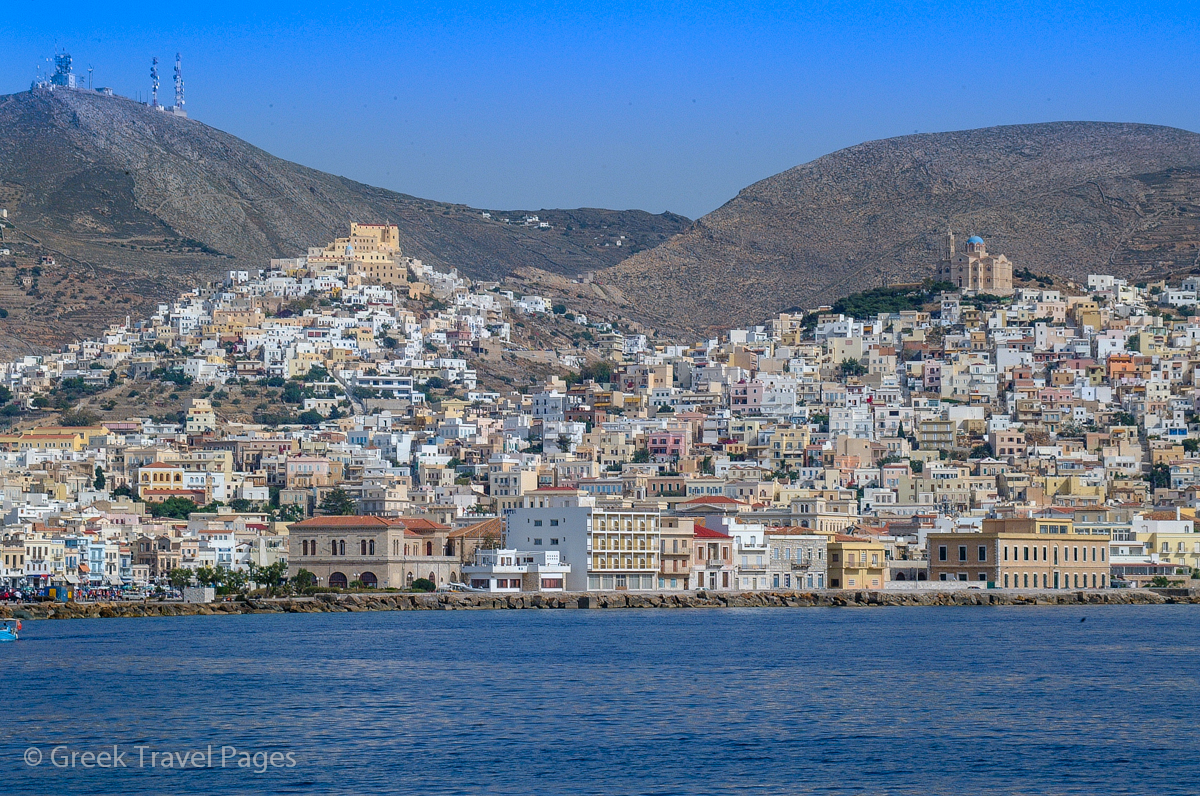
Syros is an island of the Cycladic Archipelago, of which it is also
its administrative centre. Thus its capital,
Ermoupolis
(or Hermoupolis), is also the capital of the entire archipelago. Its land
is mountainous and barren, with some fertile small valleys. Its coasts are lined
with beautiful sandy beaches and rocky inlets, lapped by the crystal waters of
the
Aegean Sea. One of the
attractions of the island is its very interesting neoclassical architecture, which
makes it different from the other
Cycladic
Islands.
Syros was inhabited from Prehistoric times and archeological finds
testify that it was an important centre of the Cycladic civilisation. The island
was first colonised by the Phoenicians, who gave it the name Syros, which means
"rocky". Later the Ionians founded two important cities, one on the
site of today’s capital and the other on the site of the village of
Posseidonia.
During the Persian Wars it was an ally of the Persians and later of
Athens.
Syros was conquered in turn by
Macedonia,
Egypt and
Rome.
In Byzantine times, it became a possession of
France
and later of
Venice. Under
the rule of these two powers, Catholicism took such a strong hold of the region
that Syros was to become the only island of the
Aegean
Sea with exclusively Catholic inhabitants.
In 1537, it fell into the hands of the Turks, but the continuous support
of
France made their domination
more tolerable. With the beginning of the War of Independence in 1821, inhabitants
from the islands of
Chios,
Psara and
Smyrni
took refuge here. They brought the art of modern shipbuilding to the island. From
this historic moment, Syros turned into an important commercial and seafaring
center of the
Aegean Sea.
Today’s capital,
Ermoupolis,
was constructed at that time.The Orthodox religion of these immigrants started
to spread throughout the island. Syros began to lose its importance only when
the
port of Piraeus became
the principal port of
Greece.