One of ουr
Dodecanese
which Iacks neither physical allure nor historical eminence. It has preserved
its immemorial name down through the centuries and carries it today with pride.
Foreign attempts to change it to "Piscopi" did not find the required
response in the island’s people and so failed.
Its mass rises up between
Rhodes
and
Kos, roughly in the middle
between these two islands. Round about and closer by it is in the company of
Nisiro
(NW),
Halki (SE) and
Simi
(NE). Το its north stretches the
Asia
Minor Knidos (Kavo-Krios).
Further along to its west is
Astipalia
and to the south it is watched over by
Karpathos
and beyond this
Kassos.
Mountainous for nearly its whole area (approximately 63 square km)
its only significant flat region is the plain of Megalo Horio (covering roughly
1/10 of the island’s surface area) whose slopes and valleys were once cultivated
its inhabitants occupied chiefly in a traditional agricultural economy, whose
basic charecteristic was Iarge households that owed their existence to the indivisibility
of the estates, as required by the Iocal custom of primogeniture.
The aspect of its mountains (the highest of which, Profiti Ilia, rises
654 m in the western part of the island), bare and rugged, with awe-inspiring
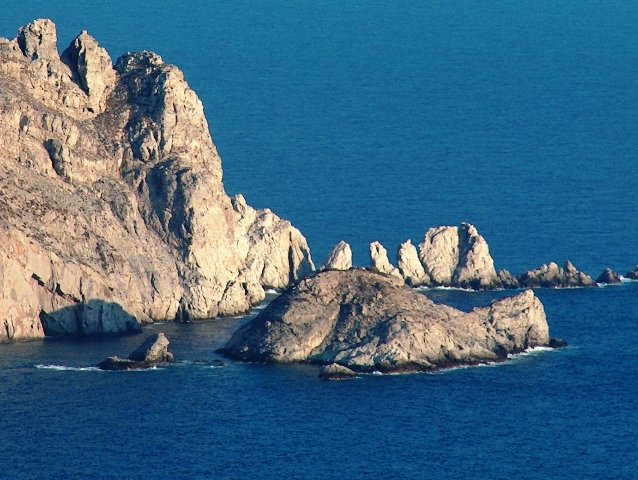
precipices, soar upwards at their peaks or plunge downwards into the sea, alternate
with Iandscapes radiating tranquillity and calm.
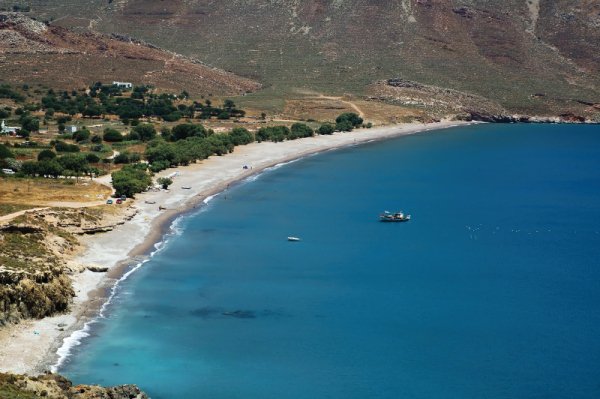
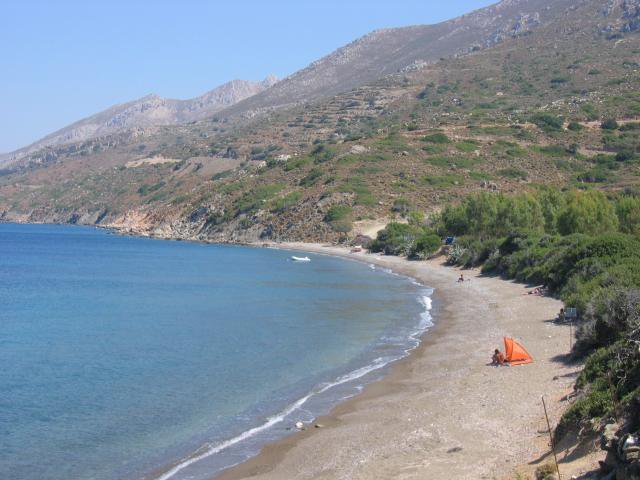
The picturesque beaches of Livadion,
Eristou,
Plaka, Skafi, Lethron of
St. Antonis, its ravines
and gorges with their water sources and the cold headsprings; and even in the
remote parts of the island at Skafi, Vathia Pigi, Agio Pantaleimona, Potamo, at
Despoti water. the verdant plain of Megalo Horio, aIl ginu a their own distinctive
picture of the island’s nature.
Its climate is dry and salubrius. The relatively high summer temperatures
are alleviated by northerly breezes that cool the island. Ιn winter though, whenever
they blow, they bring to the affected areas somewhat colder weather from the mountains
of
Asia Μinor opposite.
The first inhabitants, that Ieft traces from their habitation οn the
island, are thought to belong to the stone age.
Somehow their Iives had become intertwined with that of the elephants
that were cut off there and in time became pygmies adapting to the Iimited diet
that the place offered. Today we find the bones of these agreeable proboscians
in the Harkadio caverns beside the Missaria spring towards the frontier between
Megalo Horio and
Mikro
Ηοriο , where their existence came fuil circle about 4,500 to 3,500 years
ago, according to the calculations of the experts.
Ancient people, Karolelegians, Pelasgians, Minoans, Μyceanians Iater
οn make their presence known οn the island before the final settlement of the
Dorians when Tilos passes into the great history of Hellenism. It too is a genuine
part of it, has Iived ail its adventures, has flourished with it; enshaved it
finally gains its Iiberty with the end of the Second World War , that brought
the
Dodecanese back into
the bosom of the motherland.
This new phase in the history of Tilos found it with three towns:
Megalo Horio (the island’s
capital that kept the tittle "municipality")
Mikro
Horio and the
Livadia joined together in a second municipality
(indirectly called a parish) and with an overall permanent population of 1,102.
today with its permanent residents at around 300 and the numbers following a continuous
downward trend,
Mikro Horio
lies deserted.
Visitors to the island can see and enjoy many things: its almost unspoilt
nature, clean sea, cool waters, symbols of its piety (first among these the monastery
of St. Pan....), memories of its history, its quiet Iife, its people with their
vivid traditional performances, their unaffected manners and pleasant disposition.
One of the island’s former features though a real aesthetic delight - they
wiil not be fortunate enough to enjoy and admire: the magical aspect presented
by the blossoming almond trees in the
Megalo
Horio plain as they cast over it, come January and February, the exceptional
pale rose veil of their flowers the whole framed by the emerald green slopes with
the azure sea of
Eristou
as a backdrop. Whoever had the good fortune to witness this sight that gave Tilos
the name "island with the almond trees" never forgot it. In the place
of this vision though came something eise, just as distinctive and magnificent:
the islands pygmy elephants whose study wiIl show as we expect by faithfully reconstructing
their skeletons showing how these animaIs were in that time. This spectacle, unique
for being in
Greece but aiso
one of the most remarkable in the world and connected to that great paleontological
discovery that brought to Iight these important finds, wiIl justly give a new
name to Tilos, making now the island better known as the Elephant Island.